The Gift of Fresh Eyes: Why Beta Readers Are an Author’s Greatest Ally


Publishing for the first time is an act of pure passion. You leap into the unknown driven by the excitement of having created something of your own, but often without a safety net or any real knowledge of the publishing industry. My first foray into this world was no different: I acted on impulse and made the mistake of not submitting my manuscript to the most crucial filter.
I paid a significant sum to a literary agent for a reader's report that merely awarded me a 7/10 score and told me the manuscript had "great potential." With no deep edits or structural suggestions, I believed the book was ready. A huge mistake.
Years later, with more maturity and perspective, I reread that novel and realized how much room for improvement there was. It was then that I discovered the indispensable role of the beta reader. Artificial intelligence or specialized software can handle copyediting and proofreading, but the true value of a beta reader lies in their critical eye—trained through hundreds of stories—capable of pointing out what isn't working and confirming whether your story manages to leave a lasting impression.

The Plot Detective: When Research Blinds You
While revising my novel Soy GRANDE, I decided to flesh out secondary characters who originally barely made an appearance but deserved a voice of their own. I dove into their backstories to understand the events that had shaped their character, conducting meticulous research to recreate an impeccable historical atmosphere. However, I immersed myself so deeply in the setting that I lost sight of the bigger picture: by altering the timeline, one of the main characters' birth dates no longer added up. To fix it, I had to reshape the plot and create new characters to make all the puzzle pieces fit.
The most alarming part? I hadn't even noticed. It took one of my beta readers—as sharp as Detective Columbo himself—to spot the chronological discrepancy and save me from publishing a glaring anachronism.
Translating Isn't Just Swapping Words: Cultural and Linguistic Clashes
In the translation process, a native beta reader isn't just helpful—they are the key to success. It’s not about translating text word for word from one language to another, but about preserving the author's style, intent, and emotional intensity while adapting them to the nuances of each culture.
During the German translation of Soy GRANDE, I ran straight into this cultural wall. I had included an anecdote about a country man who, seeing his daughter's boyfriend stumble and fall, mockingly asked: «¿T'as herío? ¿Qué t'as herío, la patita de andar o la de comer?» In Spanish, the play on words between human legs (piernas) and animal paws/legs (patas) is humorous. In German, however, there is no equivalent distinction in this context. A direct translation resulted in impossible terms (Essbeine and Laufsbeine) that completely baffled my German beta reader. The anecdote was simply untranslatable. Thanks to her timely warning, I replaced that passage with a different story that is easily understood in any language and ended up being much funnier.
Covering Your Back: Titles, Covers, and Double Meanings
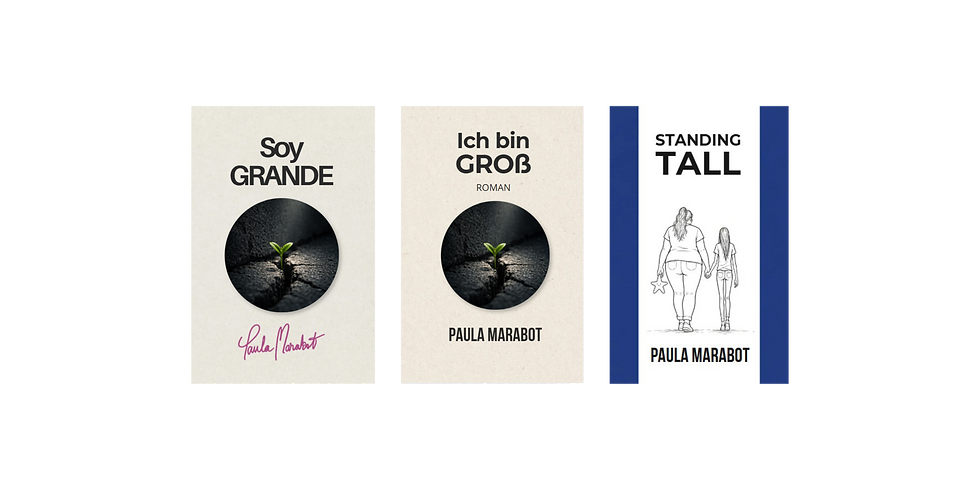
A beta reader’s judgment is essential even in strategic product packaging decisions, such as book titles and cover designs. The Spanish title Soy GRANDE plays on the double meaning of the word: physical size and inner greatness. In German, the word Groß naturally retains both senses. But when adapting the work into English, a dilemma arose: I am BIG or I am GREAT?
I initially leaned toward I am BIG, until one of my beta readers—an English teacher—warned me that this title in the Anglosphere could carry unintended sexual connotations. After evaluating numerous alternatives, we reframed the concept to STANDING TALL, a title that preserved the essence and the subtle double meaning. This change triggered a domino effect: the original cover design no longer matched the new visual narrative, forcing me to redesign it from scratch. A technical headache, but one that saved me from a commercial failure.
The True Gift
The work of a beta reader is a gift of immeasurable value to any author. They offer us their time, judgment, and honesty to smooth out the rough edges of our stories, saving us from plot holes, cultural missteps, and branding errors.
On this Reader's Day, I can only express my heartfelt gratitude to those who read with the generosity of wanting to make someone else's work better. Without their analytical and protective eyes, our books simply wouldn't be the same.


Comments